





I want to tell you about Marcus. That is not his real name. He asked me to change it because he still does not want his former employer to know the full story. But everything else in this article is exactly as he told it to me over three interviews, and I have seen the Stripe screenshots to prove it.
Marcus was a mid-level data analyst at an insurance company in Chicago. He earned $78,000 per year. He had a mortgage, a car payment, and a one-year-old daughter. He was not unhappy, but he was not free. Every Sunday evening, he felt the familiar dread of the approaching workweek. Every performance review, he wondered whether this was really it. He had ideas. He had ambition. But he also had responsibilities that made quitting his job to “follow his passion” feel reckless and selfish.
So he built a side project instead. Eighteen months later, that side project had generated $302,000 in cumulative revenue. At that point, Marcus quit his job. Not because he had to. Because the project’s monthly revenue had surpassed his salary, and staying at the insurance company was now the financially irrational choice.
This is the story of how he did it, the mistakes he made along the way, and the framework you can follow to build something similar.
The Beginning: A Problem, Not a Product
Marcus’s side project started the way most good businesses start: with a personal frustration. As a data analyst, he spent hours every week building spreadsheet reports for underwriters. The reports always followed the same format. The same columns, the same calculations, the same charts. But every week, he had to manually pull data from three different systems, clean it, format it, and email it to 15 different people.
He asked his manager if there was a tool that could automate this. His manager said: “We looked into it. The enterprise solution costs $40,000 per year and takes 6 months to implement. Just keep doing it manually.”
Marcus thought that was insane. So he built a Google Sheets template that pulled data from the three systems using API connectors and generated the reports automatically. It took him three weekends to build. The template reduced a 6-hour weekly task to 15 minutes.
He showed it to a colleague in another department. She said: “Can you make one for my team? We have the same problem but with different data sources.” He did. Then her colleague asked. Then someone in the Denver office heard about it and asked. Within two months, Marcus had built custom spreadsheet templates for five different teams, all in his spare time, all solving the same fundamental problem: manual reporting that should be automated.
The Pivot: From Free Favors to Paid Product
Here is where most people stall. They build something useful, share it for free, and never cross the threshold from “helpful colleague” to “business owner.” Marcus almost stalled there too. He was giving away templates for free and feeling good about helping people. But his daughter was not sleeping through the night, his weekends were consumed by template requests, and he was falling behind on his actual job.
The turning point came when a friend outside the insurance industry asked: “Can you build something like that for my real estate team? I will pay you.” That request made Marcus realize two things. First, the problem was not specific to insurance. Any team that produced recurring reports from multiple data sources had the same pain. Second, people would pay for this. Not out of charity. Because it saved them time, and time is money.
The pricing decision that changed everything: Marcus did not price based on what the templates cost to build. He priced based on what they saved. Each template saved the average user approximately 4 to 6 hours per week. At a conservative $30/hour value, that was $120 to $180 per week in saved time. He priced the templates at $49 for a standard version and $149 for a custom version tailored to the buyer’s specific data sources.
At those prices, the templates paid for themselves in less than one week. That is the kind of value proposition that makes buying a no-brainer.
The Launch: No Audience, No Budget, No Problem
Marcus did not have a blog. He did not have a Twitter following. He did not have an email list. He had a LinkedIn profile with 200 connections and a Google Sheet.
Step 1: He posted on Reddit. Not in r/Entrepreneur or r/SideHustle. In r/dataanalysis, r/analytics, and r/Excel. He did not pitch his product. He shared a free version of his template with a detailed explanation of how it worked. The post got 300 upvotes and 50 comments. At the bottom of the post, he mentioned: “I also build custom versions for specific teams. DM me if interested.”
That single Reddit post generated 12 custom template requests in 48 hours. At $149 each, that was $1,788 in revenue from a free Reddit post.
Step 2: He created a simple website. Using Carrd at $19 per year, he built a one-page site that described the product, showed screenshots, and had a “Buy Now” button connected to Stripe. The site was not pretty. But it was clear. Problem, solution, price, buy.
Step 3: He posted consistently in niche communities. Not spamming. Contributing. He answered questions about spreadsheet automation in Reddit, Quora, and LinkedIn groups. When someone described a problem his templates solved, he mentioned his product. This consistent, helpful presence generated 3 to 5 new customers per week for zero marketing spend.
Month 3: The First $5,000 Month
By month 3, Marcus had sold 47 standard templates and 23 custom templates. Revenue: $5,230. He was spending approximately 8 hours per week on the side project, mostly on building custom templates. The standard templates were essentially passive income after the initial build.
The key insight at this stage: Custom templates were more profitable per sale ($149 vs $49) but standard templates were more scalable. Every custom template he built revealed a new use case that could become a standard product. He started packaging the most common custom requests into standard templates at the lower price point.
Month 6: The Automation Pivot
By month 6, Marcus was earning $8,000 to $10,000 per month but hitting a ceiling. Custom templates required his personal time. He could only build 3 to 4 per week. To grow, he needed to either hire someone or automate the customization process.
He chose automation. Using Make, he built a system where customers filled out a form specifying their data sources, report format, and calculation requirements. The form data triggered a Make scenario that generated a customized template using a master template and a set of conditional logic rules. The system could not handle every request, but it handled about 70% of them, producing a customized template in under 5 minutes.
The remaining 30% of requests that were too complex for automation were flagged and handled manually by Marcus. This hybrid approach scaled his output from 3 to 4 custom templates per week to 15 to 20, with only a modest increase in his time investment.
The tool stack at this point:
- Make — $19/month for automation workflows
- Carrd — $19/year for the website
- Stripe — 2.9% per transaction for payments
- Google Forms — Free for customer intake
- Gmail — Free for customer communication
- Total monthly cost: approximately $30
Month 9: The Subscription Model
The one-time purchase model was generating solid revenue, but Marcus noticed something: customers who bought a template often came back 3 to 4 months later asking for updates when their data sources changed or their reporting requirements evolved. He was doing these updates for free because he wanted happy customers, but the updates were consuming an increasing amount of his time.
The solution was a subscription model. He launched a “Pro” tier at $19/month that included automatic template updates, priority support, and access to new templates as they were released. He also kept the one-time purchase option at a higher price ($99 for standard, $249 for custom) to incentivize the subscription.
The conversion was remarkable. Of his existing 200+ customers, 68 converted to the subscription plan within the first month. That was $1,292 in monthly recurring revenue from day one. By month 12, he had 140 subscribers generating $2,660/month in predictable, recurring revenue.
The psychology behind the subscription success: Customers were not paying for the template. They were paying for peace of mind. The knowledge that their reports would keep working even when their data sources changed was worth $19/month to busy professionals who had no interest in troubleshooting spreadsheet formulas.

Month 12: $15,000/Month and the Decision Point
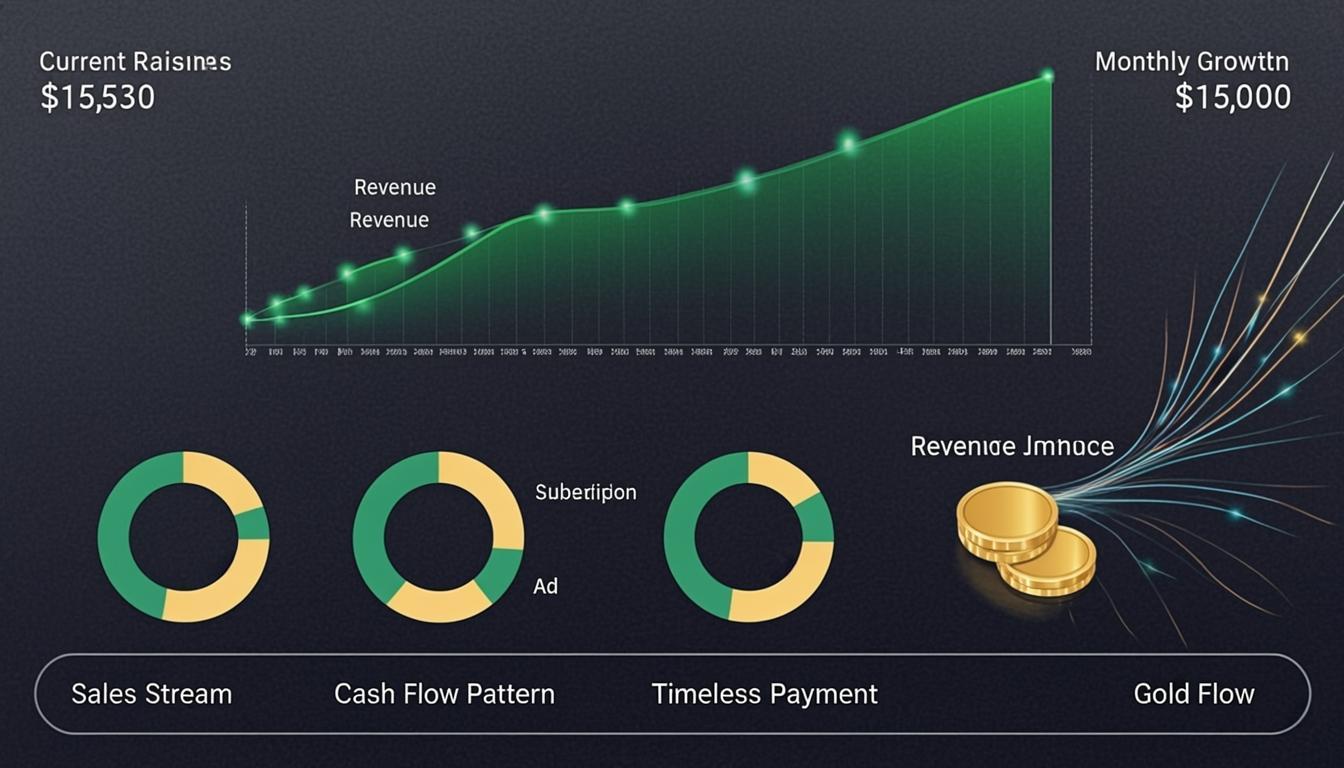
By month 12, Marcus’s side project was generating $14,800 per month. His salary at the insurance company was $6,500 per month after taxes. The project was earning more than double his day job, and the gap was widening every month.
But he did not quit. Not yet. Here is why: the project’s revenue was still concentrated in a few large customers. If his top 3 customers left, his revenue would drop by 40%. He needed to diversify his customer base before making the leap.
What he did instead: He reinvested $4,000 per month into growth. He hired a freelance content writer through Upwork at $25/hour to produce SEO-optimized articles targeting terms like “automated reporting template,” “spreadsheet automation for analysts,” and “custom Google Sheets dashboard.” He ran targeted Google Ads at $500/month. He created a referral program that gave existing customers a free month for every new subscriber they brought in.
The content strategy was the slowest to show results but the most powerful in the long run. By month 15, organic search was generating 40% of new customers. By month 18, it was generating 60%.
Month 15: Diversification and the Course Launch
At month 15, revenue hit $22,000 per month. The customer base had diversified enough that no single customer represented more than 5% of revenue. Marcus felt the business was stable enough to add a new revenue stream.
He launched a video course on Teachable called “Build Automated Reporting Dashboards in Google Sheets.” The course was priced at $149 and taught people how to build their own automated reporting systems from scratch. It was not a replacement for his templates. It was a complement. Some people wanted done-for-you templates. Others wanted to learn the skill themselves.
The course generated $6,000 in its first month and continued to produce $2,000 to $4,000 per month passively. The beautiful thing about a course is that it required roughly 40 hours to create and then sold indefinitely with zero additional effort.
Month 18: The Resignation
On a Tuesday morning in March, Marcus walked into his manager’s office and handed in his two-week notice. His side project had generated $302,000 in cumulative revenue. Monthly revenue was $28,000 and growing at 8 to 12% per month. He had 180 subscribers, 400+ one-time customers, and a growing course business.
His manager asked: “Is there anything we can do to keep you?” Marcus said: “You could have bought the tool I built for you 18 months ago. It would have saved the company $40,000 per year in analyst time. Instead, you told me to keep doing it manually. So I built it for everyone else.”
He did not say that with bitterness. He said it with the quiet confidence of someone who had built something real and knew its value.
The Framework: How to Build a $300K Side Project
Marcus’s success was not accidental. He followed a pattern that I have seen repeat across dozens of successful side projects. Here is the framework.
1. Solve your own problem first. The best side projects start with a frustration you experience personally. You understand the problem deeply, you can validate the solution immediately, and you are your own first customer.
2. Give away value before you sell. Marcus shared a free template on Reddit before he ever charged a dollar. This built trust, generated feedback, and proved that people wanted what he was building. Free value is your marketing budget when you have no marketing budget.
3. Price on value, not effort. A template that saves someone 5 hours per week is worth $49 to $149 regardless of how long it took you to build. The customer pays for the outcome, not your process.
4. Automate before you hire. Marcus used Make.com to automate 70% of custom template production before he ever hired a contractor. Automation scales without recurring costs. Hiring adds recurring costs. Automate everything you can first.
5. Convert one-time buyers to subscribers. Recurring revenue transforms a side project from a hustle into a business. Even a simple $19/month subscription for updates and support creates predictable income that compounds over time.
6. Do not quit too early. Marcus waited 18 months and until his side project earned more than double his salary before quitting. The temptation to quit at month 6 when revenue hits $5K is strong. Resist it. Build stability first. Then make the leap from a position of strength, not desperation.
What Marcus Would Do Differently
I asked Marcus what he would change if he could start over. Three things.
First, he would have started the email list on day one. “I had 200 customers before I started collecting email addresses. That is 200 people who bought from me once and might have bought again if I had stayed in touch. I left thousands of dollars on the table by not starting my list sooner.”
Second, he would have raised prices faster. “I kept prices low for too long because I was afraid nobody would pay more. When I finally raised the custom template price from $149 to $249, sales did not drop. They stayed the same. I left $100 per sale on the table for six months.”
Third, he would have built the subscription model earlier. “The subscription was the turning point. Predictable, recurring revenue changed everything about how I thought about the business. If I had launched it at month 3 instead of month 9, I would have hit $20K/month by month 10 instead of month 14.”
Your Turn
Marcus’s story is not exceptional. It is repeatable. He did not have a huge audience, venture capital, or technical cofounders. He had a problem he understood, a willingness to build on weekends, and the discipline to reinvest his earnings instead of spending them.
If you have a skill that saves people time, you have the seed of a side project. Build the simplest possible version. Share it for free in the communities where your audience lives. Listen to feedback. Charge for it when people ask for more. Automate the delivery. Add a subscription. Let it compound.
The $300K does not come from one brilliant idea. It comes from consistent execution on a problem worth solving. Start this weekend.
If you want our free “Side Project Starter Kit” with template checklists, pricing calculators, and launch checklists, email us at hello@kivora.pages.dev with the subject line “Side Project Kit.”

Your weekends are your runway. Use them wisely.