
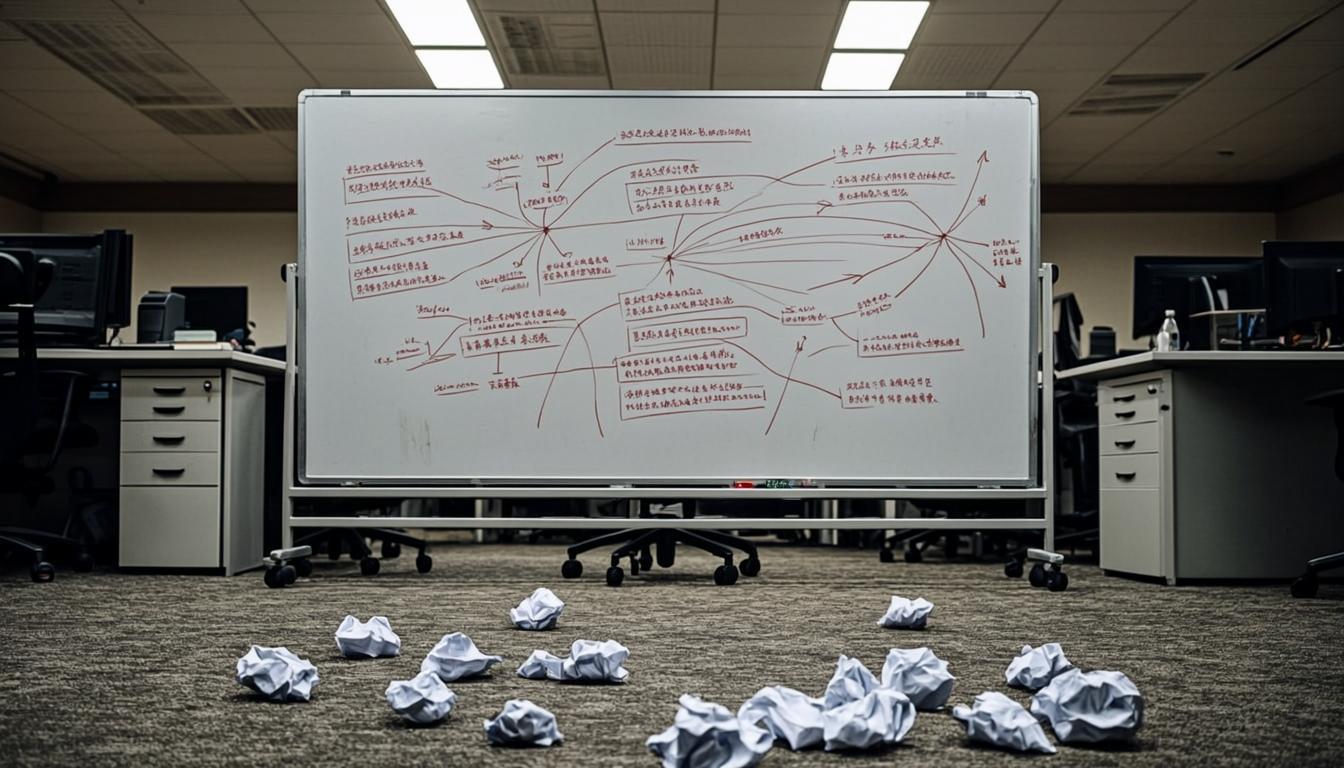




Every startup advice says the same thing: “Pivot when it’s not working.” Iterate. Adapt. Stay nimble.
James Okonkwo followed this advice perfectly. He pivoted 4 times in 18 months. Each pivot was logical. Each pivot had investor support. Each pivot burned 6 months and $200,000.
By pivot 4, his company—NexusAI—had no original team, no original product, no original customers, and $40,000 remaining. He shut down in March 2025.
This is the story of death by pivot—the specific pathology of founders who confuse motion with progress.
The Original Vision (January 2024)
NexusAI started as an AI meeting assistant. Join your Zoom calls, take notes, extract action items, update project management tools automatically.
The initial traction:
- 200 beta users
- $12,000 MRR from 40 paying teams
- 4.2/5 user satisfaction score
- Clear technical moat (proprietary audio processing)
The problem: Otter.ai, Fireflies, and Zoom’s native AI features were entering the market. Okonkwo believed differentiation required expansion.
Pivot 1: The “Platform Play” (March 2024)
The logic: Meeting notes are a feature, not a product. Build a full “AI workplace”—notes, tasks, documents, all AI-powered.
The execution: 4 months, $180,000, 3 new engineers hired.
The result: A bloated product that did 5 things poorly instead of 1 thing well. Original customers churned (they wanted better meeting notes, not a new workspace). New customers never arrived (competition from Notion, Asana, ClickUp was entrenched).
Okonkwo’s thinking: “We need to be a platform to survive.” The investors agreed. The market didn’t.
Pivot 2: The “Enterprise Pivot” (July 2024)
The logic: SMBs are too price-sensitive. Enterprises pay $50K–$500K for AI transformation. Pivot to enterprise sales.
The execution: 5 months, $220,000, hired enterprise sales lead, rebuilt for security/compliance.
The result: 2 pilot customers, both churned after 3 months. Enterprise sales cycle was 9–12 months. NexusAI had 6 months of runway. The sales lead quit when he realized the product wasn’t enterprise-ready.
Okonkwo’s thinking: “We need bigger contracts to justify our valuation.” The investors agreed. The product-market fit didn’t exist.

Pivot 3: The “Vertical Pivot” (December 2024)
The logic: Horizontal AI tools are commodities. Vertical-specific AI (legal, medical, finance) has moats. Pivot to legal AI—contract review for law firms.
The execution: 3 months, $150,000, hired legal domain expert, rebuilt entire product.
The result: 1 paying customer ($5,000/month), 3 trials that didn’t convert. The team had no legal industry credibility. The product was technically inferior to Harvey and other legal-specific tools that had been building for years.
Okonkwo’s thinking: “We need a vertical with regulation as a moat.” The investors were silent this time. The market didn’t care.
Pivot 4: The “API Infrastructure” (March 2025)
The logic: All previous pivots failed because we were building applications. The real value is infrastructure—sell AI meeting transcription API to other developers.
The execution: Never completed. $40,000 remaining. Team of 2 (down from 12). Okonkwo realized he was building a Twilio competitor with $40K and no telecom experience.
He shut down the company. Returned nothing to investors. Laid off the final employees. Spent April 2025 in bed.
The Specific Pathology
Okonkwo’s pattern isn’t unique. It’s “pivot addiction”—the belief that the next direction will solve fundamental problems with the current one.
The warning signs he ignored:
| Sign | Interpretation | Reality |
|---|---|---|
| “We just need to add [feature]” | Product gap | Market doesn’t want core product |
| “The market is too competitive” | Execution problem | No differentiation, not no effort |
| “We need bigger/smaller customers” | Go-to-market problem | Product doesn’t solve acute pain |
| “We need a different vertical” | Positioning problem | No domain expertise in new vertical |
Each pivot was a way to avoid the hard truth: the original product had modest but real traction that could have been grown with focus, and every pivot destroyed that foundation.
The Counterfactual
What if Okonkwo hadn’t pivoted?
The original meeting assistant:
- $12,000 MRR at pivot 1
- Market growing (hybrid work normalized)
- Technical moat real (audio processing)
- Clear improvement path (better integrations, accuracy)
With 18 months of focus instead of pivots:
- Conservative 15% monthly growth: $12K → $85K MRR
- Team of 6 instead of 12 (burn rate sustainable)
- Potential acquisition by Zoom, Microsoft, or Notion
- Or: profitable small business at $1M+ ARR
The pivots didn’t save the company. They killed a company that was surviving in search of one that would thrive.
The Recovery
Okonkwo spent 6 months unemployed. Therapy. Reading. Avoiding founder events.
He returned to building in late 2025 with specific constraints:
The “No Pivot” Pledge:
- 12-month commitment to any product direction
- Monthly metrics review, but no directional changes
- If metrics decline for 3 consecutive months: fix within direction, don’t abandon
- Investor conversations about “strategic alternatives” are forbidden
He’s building a simple tool now: AI-generated documentation for API endpoints. Boring. Specific. Narrow. $8,000 MRR after 4 months.
He describes it as “the product I should have built at NexusAI—something small that works, grown carefully.”
The Specific Lesson
Okonkwo’s insight: “Pivots are surgery. You do them when the patient will die otherwise. You don’t do them because the patient is uncomfortable, or growing slowly, or facing competition. We treated pivots like strategy. They’re actually emergency medicine.”
He now advises founders: “Before you pivot, write down what ‘success’ looks like in 12 months if you don’t pivot. If you can’t define it, you don’t have a pivot problem. You have an execution problem.”

Kivora documents founder decision-making and the patterns that kill companies slowly. Join the newsletter — Subscribe here.